Food systems are central to climate stability, ecosystem health and human well-being. However, current food systems are also among the main drivers of climate change, biodiversity loss and environmental degradation, while creating economic and social challenges for farming communities and food producers.
Agroecology has been widely recognised as a promising approach to address these challenges by integrating ecological principles, social innovation and food system governance. Despite this, agroecological approaches remain insufficiently implemented in many regions.
LIFT responds to this challenge by developing and testing approaches for the agroecological transformation of landscapes and regional food systems. The project applies a food systems perspective, where targeted public procurement of regional, seasonal and agroecological food acts as a key driver for change.
The LIFT project
LIFT (Living Labs for Farm and Landscape Transformation) is a research and innovation project that explores how agroecological food systems can be developed through collaborative experimentation, learning and action in real-world contexts.
Through regional Living Labs, the project brings together actors across the food system to collaboratively address challenges, explore solutions and support change.
LIFT methodology
LIFT uses a transdisciplinary, participatory and change-oriented approach based on action research in Living Labs.
Living Labs are collaborative platforms where actors from different sectors work together to address challenges, develop solutions and take action in real-world contexts.
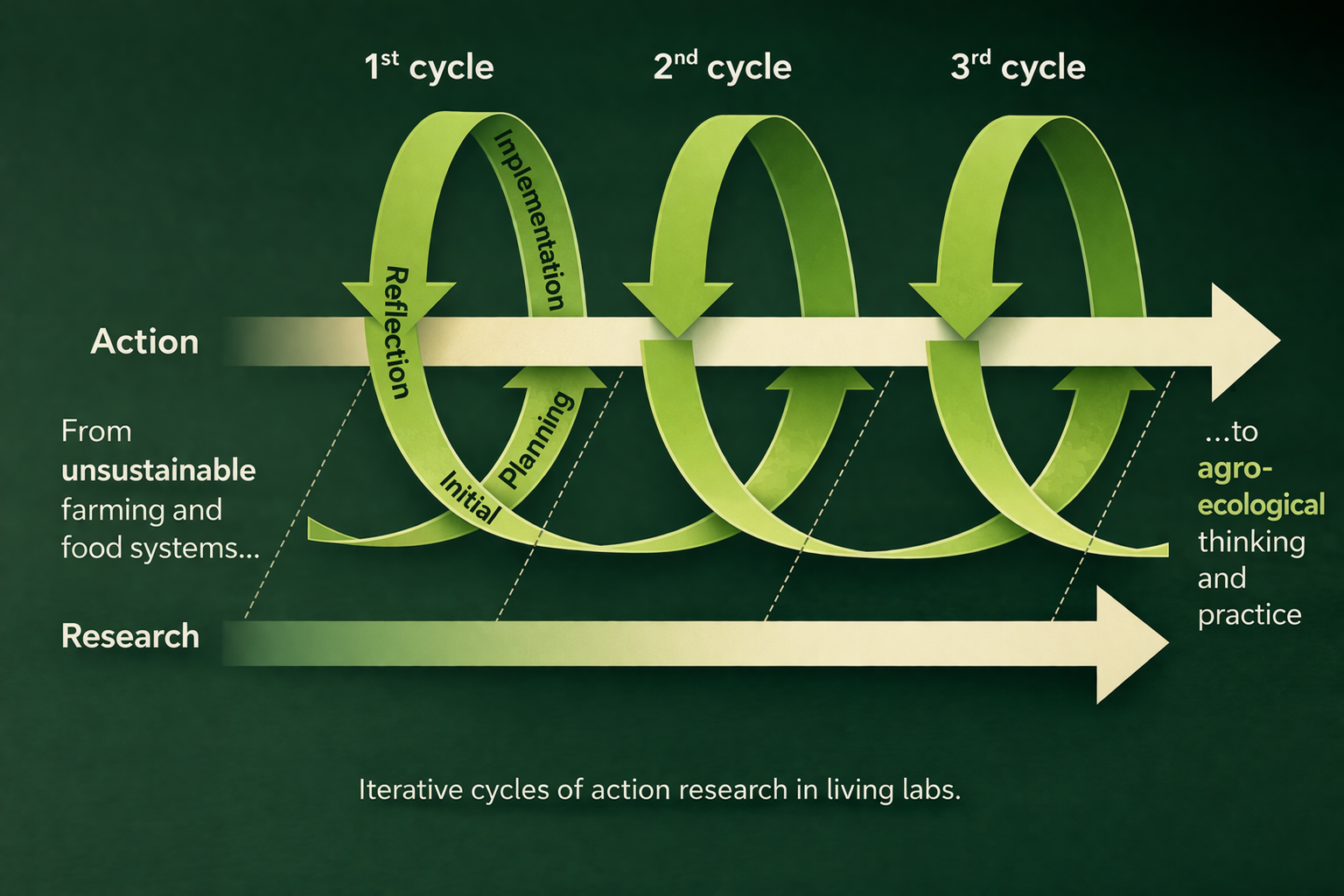
The Living Lab processes operate through iterative cycles of action and research, where actions are implemented and systematically reflected upon to inform subsequent cycles.
In LIFT, these cycles include:
- mapping the current food system context
- identifying supporting and hindring forces
- envisioning desired future scenarios
- planning and implementing action plans
- reflecting on processes and outcomes
Scientific evaluation accompanies these processes to assess outcomes and generate transferable knowledge for agroecological transformation.
Project scientists examine both the Living Lab processes and their outcomes in relation to agroecological transformation of farms, landscapes and food systems. This action research approach combines practical change processes with systematic knowledge generation across cases.
Regional Living Labs
The project builds on Living Labs in:
- Portugal
- Spain
- Sweden
- Denmark
- Norway
These regions represent diverse environmental, socio-economic and governance contexts, enabling comparison and learning across regions.
The Living Labs are established in contexts where partners are already engaged in initiatives involving multiple actor groups across the food system. These include farmers, agricultural advisers, food distributors, kitchen and canteen personnel and users, citizens, municipalities and counties, as well as decision-makers and policy actors.
Cross-regional collaboration between Living Labs supports shared learning and contributes to the development of approaches that can be applied in different contexts.
Project objectives
The main objectives of LIFT are to:
- facilitate multi-stakeholder Living Labs for developing agroecologically sound production, delivery, procurement and consumption of food in regional landscapes, and connect these in an international network of Living Labs
- explore forces that support and hinder the transition towards more collaborative, regional and agroecologically sound food systems, and develop concepts and tools to support this transition
- develop a participatory framework for evaluating impacts of Living Lab activities on the implementation of agroecological principles and practices, and on the ecological, economic and social sustainability of farms, landscapes and food systems
These objectives are addressed through participatory, multi-criteria and mixed-method approaches, contributing to societal learning about sustainability pathways.
Outputs and contributions
LIFT contributes with:
- a roadmap for organising actors to develop place-based, agroecological and collaborative food systems with enhanced social, economic and environmental sustainability
- multi-criteria sustainability analysis tools tailored to Living Labs and adaptable to new contexts
By addressing challenges in both southern and northern Europe, LIFT contributes to agroecological transformation in the landscapes concerned, to an international learning network, and to a broader shift in how sustainability challenges in agrifood systems are addressed across different environmental and socio-economic conditions.
Knowledge sharing and dissemination
Methods, tools and solutions developed in the Living Labs are disseminated and scaled through:
- collaboration with stakeholders in lighthouse cases
- the project website
- scientific publications and conferences
- social media and media outreach
- international networks and learning platforms, including Agroecology for Europe
This supports wider learning and uptake of approaches for agroecological transformation.
Actors involved
LIFT involves a diverse network of actors across the food system, including:
- farmers and agroecological practitioners
- researchers and academic institutions
- municipal decision-makers and procurement authorities
- food distributors and sector organisations
- kitchen managers and public meal professionals
- citizens and civil society organisations
Consortium
The project consortium includes research organisations, universities and civil society actors from across Europe.
Coordinator:
Professor Tor Arvid Breland
Norwegian University of Life Sciences (NMBU)
Project partners include institutions from Portugal, Spain, Sweden, Denmark and Norway working together to develop and evaluate Living Lab approaches for agroecological transformation.
Partners:
- Sara Magalhães: FCiências.ID – Association for Research and Development of Sciences, PORTUGAL
- Klara Lindegren: Svensk Kolinlagring, SWEDEN
- David Gallar: University of Córdoba (UCO), SPAIN
- Nina Isabella Moeller: University of Southern Denmark (SDU), DENMARK
- Jessica Johansson: Miljömatematik Malmö AB, SWEDEN
- Martin Melin: Halmstad University (HU), SWEDEN
- Ángel Calle: University of Extremadura (UEx), SPAIN